
FAQs – Irish Income Withholding Tax
Overview:
As an Irish company, Interactive Brokers Ireland Limited (IBIE) is generally required to collect withholding tax (WHT) at a rate of 20% on interest paid to certain clients.
This requirement is set out in section 246 of the Irish Taxes Consolidation Act 1997 and generally applies to interest paid to clients that are:
(i) natural persons resident in Ireland,
(ii) natural persons resident outside Ireland unless the client has successfully applied for an exemption or a reduction in the WHT rate under a Double Tax Treaty (DTT) between Ireland and the person’s country of residence.
(iii) Irish companies
(iv) Companies established in countries with which Ireland has NOT concluded a DTT.
Background:
The purpose of this document is to set out our responses to some frequently asked questions (FAQs) on the WHT.
This document is for information purposes only and does not constitute tax, regulatory or any other kind of advice. If you are unsure of your tax obligations please consult the Irish Revenue Commissioners, your local tax authority or an appropriate tax professional.
FAQs
What type of interest does Irish WHT apply to?
Does Irish WHT apply to interest I earn through the Stock Yield Enhancement Program?
If I earn interest through Bond Coupons, am I required to pay Irish WHT?
I do not trade Irish stocks, do I still have to pay Irish WHT?
What is the standard Irish WHT Rate?
When is the 20% WHT applied to my account?
What currency is used for Irish WHT?
I am resident in Ireland. Do I have to pay Irish WHT?
I am not resident in Ireland. Does Irish WHT apply to me?
Does WHT apply to clients who are companies?
How do I apply for an exemption from WHT or a reduced WHT rate?
What do joint account holders need to submit to obtain a WHT exemption/reduction?
Where should I send my completed Form 8-3-6?
How do I submit Form 8-3-6 and supporting documentation to IBIE?
Do I need to apply for an exemption from WHT or a reduction in the WHT rate by a certain deadline?
How do I apply to reclaim WHT applied to my account?
How long does a completed Form 8-3-6 remain valid for?
Do I have to complete a Form 8-3-6? Can I still trade if I don’t complete it?
Where can I see information relating to Irish WHT on my account statement?
How do I know what WHT rate has been agreed between my country of residence and Ireland?
WHT is a set amount of income tax that is withheld at the time income is paid to a person.
Under Irish law, interest payments are considered income. This means that IBIE is legally required to deduct WHT from credit interests on uninvested cash balances in our clients’ securities accounts.
What type of interest does Irish WHT apply to?
Irish WHT applies to credit interest paid to long settled uninvested cash balances as well as short credit interest where you have borrowed stock from IBIE.
Does Irish WHT apply to interest I earn through the Stock Yield Enhancement Program?
No. The interest you earn under the Stock Yield Enhancement Program is not within scope for Irish WHT obligations. Irish WHT only applies to credit interest paid on uninvested cash balances in your account.
If I earn interest through Bond Coupons, am I required to pay Irish WHT?
No. Interest that you earn on Bond Coupons is not within scope for Irish WHT obligations. Irish WHT applies only to credit interest paid on uninvested cash balances in your account.
I do not trade Irish stocks, do I still have to pay Irish WHT?
Yes. If your account is held by IBIE, your account is in scope for Irish WHT on credit interest payments. It is irrelevant whether or not you trade in Irish stocks.
What is the standard Irish WHT Rate?
The standard rate of WHT is 20%. You can find further information on credit interest rates on our webpage.
When is the 20% WHT applied to my account?
If IBIE is required to apply WHT to your interest payments, we will do so at the same time any credit interest is paid to your account.
IBIE pays interest due on the uninvested cash balance in your account on the third business day of the month following the month in which the interest accrued. For example, interest accrued in January will be paid on the third business day in February.
What currency is used for Irish WHT?
Irish WHT is charged in the same currency as the credit interest paid on the uninvested cash balances in your account.
I am resident in Ireland. Do I have to pay Irish WHT?
Yes. Under Irish tax law, all Irish resident individuals and partnerships are subject to 20% WHT on credit interest payments. Irish companies are also subject to WHT, although some limited exemptions may apply.
I am not resident in Ireland. Does Irish WHT apply to me?
Yes, generally Irish WHT applies to natural persons whether or not they reside in Ireland.
However, if Ireland has entered a Double Taxation Treaty (DTT) with your country of residence, that DTA may allow you to apply for an exemption from or reduction in WHT, depending on its terms. Please see further below.
You can find information about Ireland’s DTTs on the Irish Revenue website https://www.revenue.ie/en/tax-professionals/tax-agreements/rates/index.aspx
Does WHT apply to clients who are companies?
WHT does not apply to companies resident in countries that have a DTT with Ireland.
In general, WHT applies to Irish resident companies with a few exceptions, including;
(a) an investment undertaking within the meaning of section 739B of the Taxes Consolidation Act 1997,
(b) interest paid in the State to a qualifying company (within the meaning of section 110).
For a full list of exemptions, please refer to Section 246(3) of the Taxes Consolidation Act.
There is no standard exemption form for corporate clients. In order to avail of these exemptions, clients will have to provide proof of their corporate status requested by IBIE.
How do I apply for an exemption from WHT or a reduced WHT rate?
If you wish to apply for a WHT exemption or reduction under the terms of a DTT, you should complete Form 8-3-6, and return that Form to IBIE.
The following is a summary of the information you must provide when completing Form 8-3-6:
1. Your name (please ensure this matches the name on your IBKR account)
2. Your address
3. Your tax reference number in country of residence
4. The country in which you are tax resident
5. The WHT rate agreed between your country of tax residence and Ireland (see FAQ on this topic).
6. Signature.
7. Date.
You must request your local Tax Authority to sign and stamp Form 8-3-6 before returning it to us.
For more detailed information on how to complete Form 8-3-6, please refer to the Irish Revenue Commissioners’ website here https://www.revenue.ie/en/companies-and-charities/financial-services/withholding-tax-interest-payments/index.aspx
If you have asked your local tax authority to sign Form 8-3-6 and they have refused, you can instead submit a Tax Residency Certificate (TRC) from your local Tax Authority, with a completed Form 8-3-6 that has not been signed and stamped by your local tax authority. Revenue introduced this possibility in January 2023, after being informed by IBIE of the difficulties clients were experiencing in completing the Form.
To be acceptable, the TRC must explicitly state that you are tax resident in your country of residence in accordance with the relevant provision of the double taxation treaty between Ireland and your country of residence.
Please note that a TRC will only be accepted where you have first requested your local tax authority to sign and stamp Form 8-3-6 and it has refused to do so or has failed to do so within a reasonable time.
Form 8-3-6 and information about completing the Form 8-3-6 is available on the website of the Irish Revenue Commissioners.
To assist you, IBIE has also prepared a number of versions of Form 8-3-6 with certain information pre-filled, depending on your jurisdiction of tax residency. You can select the most appropriate form from the list below.
Form 8-3-6 has been translated into French, German, Spanish, Italian and Dutch*
1. EEA countries with 0% Withholding Tax.
2. EEA countries with rates above 0% Withholding Tax.
|
|
3. Other countries with a DTA with Ireland (* denotes where there is 0% withholding tax in all situations).
|
Georgia |
Moldova |
Singapore |
|
|
Armenia |
Ghana |
Montenegro |
South Africa* |
|
Australia |
Hong Kong |
Morocco |
South Korea* |
|
Bahrain* |
India |
New Zealand |
Switzerland* |
|
Belarus |
Israel |
North Macedonia* |
Thailand |
|
Bosnia & Herzegovina* |
Japan |
Norway |
Turkey |
|
Botswana |
Kazakhstan |
Pakistan |
Ukraine |
|
Canada |
Kenya |
Panama |
United Arab Emirates* |
|
Chile |
Kosovo |
Qatar* |
United Kingdom* |
|
China |
Kuwait* |
Russian Federation* |
United States of America* |
|
Egypt |
Malaysia |
Saudi Arabia* |
Uzbekistan |
|
Ethiopia |
Mexico |
Serbia |
Vietnam |
|
|
|
|
Zambia* |
What do joint account holders need to submit to obtain a WHT exemption/reduction?
Each account holder in a joint account needs to complete their own documentation. This means that a separate Form 8-3-6 must be completed by each account holder and (if relevant) a separate TRC must be provided by each account holder.
Where should I send my completed Form 8-3-6?
You should send your completed Form to IBIE. You should NOT send the Form to Irish Revenue.
How do I submit Form 8-3-6 and supporting documentation to IBIE?
You should email a PDF or JPEG copy of the signed form to tax-withholding@interactivebrokers.com. If you have not been able to obtain a stamp from your local tax authority, please ensure that you also email your Tax Residency Certificate (TRC) to this same email address.
Alternatively, you can upload your signed Form 8-3-6 to your Client Portal through the ‘Document Submission Task’ tab. However, if you are submitting a TRC with your Form you will still need to send this separately to the above email address.
Please put your IBIE account number in the email subject line in all email correspondence. A failure to do so may delay or prevent the processing of your application,
If your submitted documentation is in order, IBIE will send you a confirmation email stating that your Form has been received and processed.
If your submitted documentation is not in order, we will send you an email setting out the additional information or documentation we require to process your application.
Please follow up with IBIE if you have not heard from us within four weeks.
Do I need to apply for an exemption from WHT or a reduction in the WHT rate by a certain deadline?
There is no deadline. However, for applications made in 2023, a WHT exemption or rate reduction will only apply to interest payments made after IBIE has received a complete application.
If we have not processed your Form 8-3-6 by the time the next interest payment is made to your account we will refund any WHT deducted after the date we received your application. Refunds will be visible in the Withholding Tax section of a statement.
Yes, if you are not subject to WHT, or are subject to a reduced WHT rate by virtue of a Double Taxation Treaty between Ireland and your country of residence, you will be entitled to reclaim WHT paid in excess of the WHT rate set out in the DTT.
How do I apply to reclaim WHT applied to my account?
Generally, the application process (i) to apply for an exemption from WHT or a reduction in the WHT rate going forward and (ii) to reclaim WHT already charged, are two separate processes. IBIE is awaiting full details from the Irish Revenue Authority on how clients can make reclaims on WHT and will make these details available once provided.
However, for 2022, Revenue has agreed to allow a completed Form 8-3-6 (signed and stamped by the relevant Tax Authority) received by IBIE before 31 December 2022, to be used to reclaim WHT applied in 2022. This means that if IBIE received a completed form from you on or before 31 December 2022 and WHT was applied to your account from January – December 2022, IBIE will refund all or part of that WHT, depending on Ireland’s arrangements with your tax jurisdiction.
If you did not provide a Form 8-3-6 before 31 December 2022 or, if you provided a Form 8-3-6 but it was incomplete (for example by not being stamped by your local tax authority), you must separately apply for a full or partial reclaim of WHT paid in 2022 and 2023. Further details on the reclaim process may be found in an article titled Irish Tax Withholding Reclaim Process. For your convenience, the full article may be viewed here.
How long does a completed Form 8-3-6 remain valid for?
A fully completed Form 8-3-6 remains valid for 5 years unless there is a material change in your facts and circumstances. This also applies if you have provided IBIE with a TRC in lieu of having your Form 8-3-6 stamped by your local tax authority. If there is a material change to your circumstances from a tax perspective, you must advise IBIE immediately and provide an updated Form 8-3-6 where appropriate. For example, if you move tax residency from one country to another, you should advise IBIE and provide IBIE with a Form 8-3-6, signed and stamped by your local tax authority from your new country of residence.
Do I have to complete a Form 8-3-6? Can I still trade if I don’t complete it?
You do not have to complete Form 8-3-6 and you will still be able to trade if you do not complete the form.
However, if you do not complete Form 8-3-6 IBIE must continue to deduct WHT at a rate of 20% from the credit interest earned on cash balances in your account.
Where can I see information relating to Irish WHT on my account statement?
You can review information relating to Irish WHT in the ‘Withholding Tax’ section of your monthly account activity statement.
You can also view this information in your daily statement on the 3rd business day of the month (when credit interest is paid).
Please see the IBIE website here for more information: https://www.interactivebrokers.ie/en/index.php?f=46788
How do I know what WHT rate has been agreed between my country of residence and Ireland?
This information is available from the Irish Revenue Commissioners and/or your own local tax authority. However, in order to assist you, IBIE has also prepared a list of Irish WHT information by jurisdiction below.
By clicking on the country below, it will bring you to the relevant Form 8-3-6.
*Form 8-3-6 has been translated into French, German, Spanish, Italian and Dutch*
1. EEA countries with 0% Withholding Tax.
2. EEA countries with rates above 0% Withholding Tax.
|
|
3. Other countries with a DTA with Ireland (* denotes where there is 0% withholding tax in all situations).
|
Georgia |
Moldova |
Singapore |
|
|
Armenia |
Ghana |
Montenegro |
South Africa* |
|
Australia |
Hong Kong |
Morocco |
South Korea* |
|
Bahrain* |
India |
New Zealand |
Switzerland* |
|
Belarus |
Israel |
North Macedonia* |
Thailand |
|
Bosnia & Herzegovina* |
Japan |
Norway |
Turkey |
|
Botswana |
Kazakhstan |
Pakistan |
Ukraine |
|
Canada |
Kenya |
Panama |
United Arab Emirates* |
|
Chile |
Kosovo |
Qatar* |
United Kingdom* |
|
China |
Kuwait* |
Russian Federation* |
United States of America* |
|
Egypt |
Malaysia |
Saudi Arabia* |
Uzbekistan |
|
Ethiopia |
Mexico |
Serbia |
Vietnam |
|
|
|
|
Zambia* |
Benchmark Interest Calculation – Reference Rate Descriptions
|
Currency
|
Reference rate
|
Description
|
|
USD
|
Fed Funds Effective
|
Volume weighted average of the transactions processed through the Federal Reserve between member banks. It is intended to reflect the best estimate of interbank financing activity for Reserve Bank members and is the reference for many short-term money market transactions in the broader market.
|
| AED | EIBOR | Is the daily reference rate at which the Panel Banks are able and willing to access UAE Dirham funding, just prior to 11:00 local time. The Contributor Banks use a waterfall in order to contribute their Contributions. For Level 1 of the waterfall, volume weighted average prices of all eligible unsecured Saudi Riyal transactions are used. |
|
AUD
|
RBA Daily Cash Target
|
Refers to a 1-day rate set by the Reserve Bank of Australia to influence short term interest rates.
|
| BGN | LEONIA Plus (Lev Overnight Index Average Plus) | Is a weighted reference rate of concluded and effected overnight deposit transactions on the interbank market. |
|
BRL
|
Brazil CETIP DI Interbank Deposit Rate
|
Brazil’s Interbank Deposit Rate is the daily average annualized rate calculated by the number of business days in the month, of the one-day interbank deposit rates.
|
|
CAD
|
Bank of Canada Overnight Lending Rate
|
Refers to a 1-day rate set by Bank of Canada to influence short term interest rates.
|
|
CHF
|
SARON
|
Stands for Swiss Average Rate Overnight and represents the overnight interest rate of the secured funding market for the Swiss Franc. SARON is administered by SIX.
|
|
CNH
|
CNH HIBOR
|
Stands for Hong Kong Interbank Offered Rate and is the offered rate at which deposits in CNH are being quoted to prime banks in the Hong Kong interbank market.
|
|
CZK
|
PRIBOR
|
Average interest rate at which term deposits are offered between prime banks.
|
|
DKK
|
Denmark Tomorrow/Next
|
The interest rate at which a bank is prepared to lend Danish kroner to a prime bank on an uncollateralized basis day to day.
|
|
EUR
|
€STR
|
Stands for Euro Short-Term Rate and is the rate which reflects the wholesale euro unsecured overnight borrowing costs of euro area banks. The rate is published by the ECB and is based on transactions conducted and settled on the previous day and which are deemed to be executed at arm’s length and thereby reflect market rates in an unbiased way.
|
|
GBP
|
SONIA
|
Stands for Sterling Overnight Index Average and is the effective overnight interest rate paid by banks for unsecured transactions in the British sterling market. SONIA is administered by the Bank of England.
|
|
HKD
|
HKD HIBOR
|
Stands for Hong Kong Interbank Offered Rate and is the offered rate at which deposits in HKD are being quoted to prime banks in the Hong Kong interbank market.
|
|
HUF
|
BUBOR
|
Stands for Budapest Interbank Offered Rates and is the average interest rate at which term deposits are offered between prime banks.
|
| HUF | Hungary 3 Month Treasury Bill | Is an annualized yield on Hungarian 3 month Treasury bills. |
|
ILS
|
TELBOR
|
Stands for Tel Aviv Inter-Bank Offered Rate and is based on interest rate quotes by a number of contributors in the inter-bank market.
|
|
INR
|
Indian Rupee Overnight Interest Rate Fixing
|
A rate based on overnight call money trade data from the NDS-Call system within the first hour of trading.
|
|
JPY
|
TONAR
|
Stands for Tokyo Overnight Average Rate and is a measure of the cost of borrowing in the Japanese yen unsecured overnight money market for Japanese Yen. TONAR is administered by the Bank of Japan.
|
|
KRW
|
KORIBOR
|
Average of the leading interest rates for KRW as determined by a group of large Korean banks. The benchmark utilizes the KORIBOR with 1 week maturity.
|
|
MXN
|
TIIE
|
The interbank "equilibrium" rate based on the quotes provided by money center banks as calculated by the Mexican Central Bank. The benchmark TIIE is based on 28-day deposits so is atypical as a measure for short term funds (most currencies have an overnight or similar short-term benchmark).
|
|
NOK
|
Norwegian Overnight Weighted Average
|
The interest rate on unsecured overnight interbank loans between banks that are active in the Norwegian overnight market.
|
|
NZD
|
NZD Daily Cash Target
|
Refers to a 1-day rate set by the Reserve Bank of New Zealand to influence short term interest rates.
|
|
PLN
|
WIBOR
|
Stands for Warsaw Interbank Offered Rates and is a measure of unsecured deposits concluded between market participants.
|
| RON | ROBOR (Romanian Overnight Interbank Offered Rate) | Calculated daily as a trimmed arithmetic average of the quotations by main banks on the interbank market. |
| SAR | SAIBOR | Is a daily benchmark using contributions from a panel of Contributor Banks. The Contributor Banks use a waterfall in order to contribute their Contributions. For Level 1 of the waterfall, volume weighted average prices of all eligible unsecured Saudi Riyal transactions are used. |
|
SEK
|
STIBOR
|
Daily fixing based on a group of large Swedish banks.
|
|
SGD
|
SOR
|
Stands for the SGD Swap Offer Rate and represents the cost of borrowing SGD synthetically by borrowing USD for the same maturity and swapping USD in return for SGD.
|
|
TRY
|
TLREF
|
The Turkish Lira Overnight Rate (TLREF) is calculated as the volume-weighted mean rate, based on the central 70% of the the volume-weighted distribution of overnight repo rate transactions. |
|
ZAR
|
SABOR
|
Stands for South African Benchmark Overnight Rate and is calculated based on interbank funding.
|
|
|
|
|
|
|
|
|
|
|
Overnight
|
(O/N) rate is the most widely used short term benchmark and represents the rate for balances held from today until the next business day.
|
|
|
Spot-Next
|
(S/N) refers to the rate on balances from the next business day to the business day thereafter. Due to time zone and other criteria, Spot-Next rates are sometimes used as the short-term reference.
|
|
|
Day-Count conventions:
|
IBKR conforms to the international standards for day-counting wherein deposits rates for most currencies are expressed in terms of a 360-day year, while for other currencies (ex: GBP) the convention is a 365-day year.
|
Methodology for Determining Effective Rates
BACKGROUND
In determining the interest that account holders are paid on cash credit balances and charged on debit balances, each currency is assigned an IBKR Reference Benchmark rate. The IBKR Reference Benchmark rate is determined from short-term market rates but capped above/below widely used external reference rates or, where appropriate, bank deposit rates. This page explains how IBKR Reference Benchmark rates are determined.
Reference Rates
Reference rates are determined using a three-step process. The rates are capped above/below traditional external reference rates. For currencies and IBKR affiliates where Forex swap market pricing does not affect the rates we pay and charge our customers, Step 1 is omitted from the final rate determination.
1. Market implied rates
For market pricing, we utilize short-term Forex swap markets. Since most of the transactions involve the US dollar, Forex swap prices of currencies vs. the US dollar are sampled over a pre-determined time period referred to as the "Fixing Time Window" that is intended to be representative of liquid trading hours and primary turnover. The specific swap tenor and fixing windows used depend on the currency. We use the best bid and ask from a group of up to 12 of the largest Forex dealing banks to calculate the implied non-USD short-term rates - generally Overnight (T/T+1), Tom Next (T+1/T+2) or Spot Next (T+2/T+3). At the Fixing Time Window close, these calculations are sorted with the lowest and highest rates disregarded and the remainder averaged to determine the market implied reference rate.
2. Traditional external benchmark reference rates
For traditional benchmarks, we utilize published reference rates and, where appropriate, bank deposit rates. These rates generally are determined by either bank survey or actual transactions. The Hong Kong Inter-Bank Offered Rate (HIBOR), for example, is determined by surveying a panel of banks for the rate at which they could borrow funds from other banks at a specific time each day. In contrast, the US dollar Fed Funds effective rate is calculated as the weighted average of interbank lending rates transacted in the Fed Funds market.
The reform on interest rate benchmarks (IBOR reform), launched in 2013 by the G20 nations and conducted by regulatory authorities and public and private sector working groups, is gradually replacing bank survey based rates with new transaction driven reference rates.
3. IBKR Reference Benchmark Rates
The final IBKR Reference Benchmark rates are then determined by using the market implied reference rate, as described in 1. above, but capped by a certain amount above/below the traditional external benchmark reference rate as described in 2. above. For currencies and IBKR affiliates where Forex swap market pricing is not relevant, the final IBKR Reference Benchmark rates are determined by using traditional benchmarks or bank deposit rates, capped as above. The caps can change at any time without explicit prior notice and are listed in the table below, along with relevant currency and benchmark reference rates.
Examples
a. Assume the market implied overnight rate for GBP is 0.55%. The Sterling Overnight Index Average (SONIA) reference rate is 0.65%. The effective rate is then equal to the market implied rate of 0.55%, as it is still within the 1.00% cap around the SONIA reference rate at 0.65%.
b. If, for example, the market implied rate for CNH was 4.5% but the overnight CNH reference rate for the same period was 1.0%, the effective rate would be capped at 2.0% above the CNH reference rate, or 3.0% (1.0% reference rate + 2.0% cap).
|
Currency
|
Benchmark Description
|
Cap Below1
|
Cap Above1
|
|
USD
|
Fed Funds Effective (Overnight Rate)
|
0.00%
|
0.00%
|
|
AUD
|
RBA Daily Cash Rate Target
|
1.00%
|
1.00%
|
| AED | EIBOR, Emirates Interbank Offered Rate | 3.00% | 3.00% |
|
CAD
|
Bank of Canada Overnight Lending Rate
|
1.00%
|
1.00%
|
|
CHF
|
Swiss Average Rate Overnight (SARON)
|
1.00%
|
1.00%
|
|
CNY/CNH
|
CNH HIBOR Overnight Fixing Rate (TMA)
|
2.00%
|
2.00%
|
|
CZK
|
Prague ON Interbank Offered Rate
|
1.00%
|
1.00%
|
|
DKK
|
Danish Tom/Next Index
|
1.00%
|
1.00%
|
|
EUR
|
Euro Short-Term Rate (€STR)
|
1.00%
|
1.00%
|
|
GBP
|
Sterling Overnight Index Average (SONIA)
|
1.00%
|
1.00%
|
|
HKD
|
HKD HIBOR (Overnight rate)
|
1.00%
|
1.00%
|
|
HUF
|
Budapest Interbank Offered Rate
|
1.00%
|
1.00%
|
|
ILS
|
Tel Aviv Interbank Offered O/N Rate
|
1.00%
|
1.00%
|
|
INR
|
Central Bank of India Base Rate
|
0.00%
|
0.00%
|
|
JPY
|
Tokyo Overnight Average Rate (TONAR)
|
1.00%
|
1.00%
|
|
KRW
|
Korean Won KORIBOR (1 week)
|
0.00%
|
0.00%
|
|
MXN
|
Mexican Interbank TIIE (28 day rate)
|
3.00%
|
3.00%
|
|
NOK
|
Norwegian Overnight Weighted Average
|
1.00%
|
1.00%
|
|
NZD
|
New Zealand Dollar Official Cash Daily Rate
|
1.00%
|
1.00%
|
|
PLN
|
WIBOR (Warsaw Interbank Overnight Rate)
|
1.00%
|
1.00%
|
| SAR | SAIBOR Saudi Arabia Interbank Offered Rate | 3.00% | 3.00% |
|
SEK
|
SEK STIBOR (Overnight Rate)
|
1.00%
|
1.00%
|
|
SGD
|
Singapore Dollar SOR (Swap Overnight) Rate
|
1.00%
|
1.00%
|
|
TRY
|
TRLIBOR (Turkish Lira Overnight Interbank offered rate)
|
NO CAP
|
NO CAP
|
|
ZAR
|
South Africa Benchmark Overnight Rate on Deposits (Sabor)
|
3.00%
|
3.00%
|
1 Caps or the deviation for the effective rate allowed above or below the benchmark fixing can change at any time without explicit prior notice.
Introduction to Market Implied Rates
BACKGROUND
In determining the interest that account holders are paid on cash credit balances and assessed on debit balances, each currency is assigned a reference or benchmark rate, from which a spread is deducted for credit interest and added for debit interest.1 As account holders may withdraw unencumbered cash balances upon demand and regulations generally restrict the reinvestment of such balances to short-term instruments of high credit quality, benchmarks typically represent the rate at which local banks may borrow on an overnight or short-term basis (e.g., EONIA, Fed Funds).
While the current benchmarks are useful in that they tend to be longstanding, widely accepted and published rates, often used as the basis for determining consumer borrowing, some have characteristics which limit their effectiveness, particularly in the case of brokerage accounts where the spread as applied by IBKR is relatively narrow. A discussion of these limitations is provided in the overview below.
OVERVIEW
Benchmark rates are often determined by either bank survey or actual transactions. The Hong Kong Interbank Offered Rate (HKD HIBOR), for example, is determined by surveying a panel of banks for the rate at which they could borrow funds from other banks of at a specific time each day. The final rate is determined by discarding a set of the top and bottom survey responses and averaging the remainder. Transaction based benchmarks such as EONIA are determined using a weighted average of all overnight unsecured lending transactions by panel banks in the interbank market as reported to the European Central Bank.
There are shortcomings to both methods which, at times, causes them to be an inadequate mechanism for establishing client debit and credit interest rates. Examples of these are provide below:
- Survey rates often represent an offer rate which, by definition stands above the bid rate and can be skewed well above the mid-point when spreads are large;
- Survey rates are typically based upon an inquiry performed at a specific time of the day and may not represent the rates available over a broader period of time;
- The population of institutions surveyed or whose transactions are considered may be small and/or may have borrowing characteristics that are not representative of financial institutions as a whole;
- During periods of market stress, interbank transactions may suffer from reduced liquidity, on either a regional or global basis, thereby distorting benchmark rates.2
- Survey processes often provide little transparency as to how the benchmark was determined and in the past have been subject to manipulation.
AN ALTERNATIVE APPROACH - MARKET IMPLIED RATES
To address these shortcomings, IBKR proposes to implement an alternative method for determining benchmark rates which we refer to as Market Implied Rates. This method combines the optimal attributes of each of the survey and transaction methods and uses as its basis Forex swap prices and the interest rate differentials embedded therein. The Forex swap market is one of the largest and most competitive markets with a daily turnover of 2.4 trillion USD3, representing aggregate transactions well in excess of that used for the current transaction-based benchmarks.
As over 90% of these transactions involve the U.S. Dollar, Forex swap prices of currencies vs. the U.S. Dollar will be sampled over a pre-determined time period referred to as the “Fixing Time Window” that is intended to be representative of liquid hours and primary turnover. The specific swap tenor and fixing windows used depend on the currency. Using the best bid and ask from a group of up to 12 of the largest Forex dealing banks4, implied non-USD short-term rates (generally Overnight (T/T+1, Tom Next (T+1/T+2) or Spot Next (T+2/T+3) ) will be calculated. At the Fixing Time Window close, these calculations will be sorted with the lowest and highest disregarded and the remainder averaged to determine the Final Fixing Rate. This Final Fixing Rate will then be used as part of the effective rate for that day’s interest calculations.
To provide complete transparency as to the rates used to determine interest on client credit and debit balances, IBKR has historically posted and updated to the public website each day all of the information an account holder would need to determine the interest they might pay or receive on cash balances (e.g., the stated benchmark, current and historical benchmark levels, spreads and tiers). Similar transparency will be provided with the implementation of Market Implied Rates. Here, rates will be posted to the website in 3 stages:
- Live – the last benchmark rate calculated prior to the start of the current day’s Fixing Time Window;
- Fixing Period – represents a running calculation of the current day’s benchmark rate using available data obtained while Fixing Time Window remains open.
- Fixing – the benchmark rate as calculated upon close of the Fixing Time This rate will remain unchanged for the remainder of the day and serve as the benchmark rate.
NEXT STEPS
Merging interest rate benchmarks and Market Implied Rates is intended to better align the rates offered to clients to the true funding costs and opportunities available to IBKR. The analysis performed thus far suggests that for certain currencies the new benchmark (effective rate) resulting from Forex swap implied rates but capped 25 bps5 above/below the benchmark fixing will be higher at various times and for others lower. As for the impact to clients, a higher benchmark generally benefits depositors and a lower, borrowers. What is important is that the new methodology is calculated in a consistent manner, using readily available and substantially representative data.
As the proposed change is significant in terms of its logic and its potential impact to certain clients, IBKR has been calculating and displaying, but not yet applying, market implied rates until clients have had sufficient opportunity to review the data. By August 1, 2017 we will start migrating the benchmarks from fixed to the new system where we use effective rates which are composed of market implied interest rates capped 25 bps above or below the current benchmark fixings.
______________________________________________________________________________________
1 In the case of the USD, a spread of 0.50% is deducted from the benchmark for purposes of credit interest and a spread of 1.50% added for purposes of debit interest. The benchmark rate for the USD is the Fed Funds Effective Overnight Rate.
2 Examples of this were experienced during the financial crisis of 2007-2010.
3 Source: BIS Triennial Central Bank Survey, Forex turnover April 2016. http://www.bis.org/publ/rpfx16fx.pdf
4 The actual number of banks selected may vary by currency.
5 The 25 basis points is subject to change at any time without advance notice.
How to determine if you are borrowing funds from IBKR
If the aggregate cash balance in a given account is a debit, or negative, then funds are being borrowed and the loan is subject to interest charges. A loan may still exist, however, even if the aggregate cash balance is a credit, or positive, as a result of balance netting or timing differences. The most common examples of this are as follows:
1. Long vs. Short Currency Balances – accounts holders may borrow cash denominated in one currency if it can be secured by a credit balance in another. Take, for example, a USD base currency account holding a long USD settled cash balance of 10,000, a short EUR settled cash balance of 5,000, with a EUR.USD exchange rate of 1.38:1. Here, for statement reporting and interest computation purposes, the overall cash balance is a USD credit of 3,088 (10,000 – (5,000 * 1.38)). As each currency is subject to a unique funding and reinvestment arrangement, the short balance would be subject to financing costs based upon its benchmark rate and tier. This cost may be offset by any interest earned on the long balance based upon its benchmark rate and tier.
2. Gross Balances by Segment – IBKR’s Universal Account contains multiple sub accounts or segments, each of which holds positions and collateral which, for regulatory and customer protection purposes, may not be commingled. This separation does not allow for netting of balances across segments and a credit in one segment may therefore not offset a debit in another. Take, for example, an IBLLC account holding both securities and commodities positions with the securities segment maintaining a debit cash balance of USD 3,000 and the commodities segment a credit cash balance of USD 8,000. While the account holds an overall net credit balance of USD 5,000, the short balance would be subject to an interest charge which may be partially offset by any interest earned on the long balance.
3. Short Sales – a short sale is a margin transaction in which the account holder is borrowing stock rather than cash. While the proceeds from the short sale are credited to the cash balance of the account, these funds must be posted with the lender of the shares as collateral to secure their return. As a result, and in recognition of the fact that the loan transaction is subject to its own financing terms, the cash collateralizing the loan is excluded for the purpose of determining whether a margin loan exists.
As example, consider an account reporting net liquidating equity (all balances in USD) of 9,000 comprised of a credit cash balance of 4,000, long stock valued at 10,000 and short stock valued at 5,000. In order to determine whether funds are being borrowed to finance the long stock position, the 5,000 portion of the cash pledged as collateral to the lender of the shares is deducted from the overall 4,000 cash balance, resulting in a 1,000 debit. This debit is subject to interest charges and the cash underlying the stock borrow either an interest charge in the case of hard to borrow shares or a short stock rebate if the shares are easy to borrow and reinvestment rates sufficiently high.
4. Unsettled Funds - borrowings are determined based upon settled funds and the time frame by which payment is due or received for a given transaction is product specific (e.g., stocks generally settle in 3 business days, spot currencies 2 and derivatives 1). For statement and trading platform purposes, cash balances are reported on a trade date rather than settlement date basis, as if settlement has completed.
As a result, an account reporting a credit cash balance may, in fact, still be carrying a margin loan if that balance includes proceeds from the sale of stock purchased with borrowed funds awaiting settlement. Similarly, an account may report a trade date based debit balance, but not yet incurring a margin loan and interest charges, as the trade has not yet settled.
For additional information regarding interest calculations, please refer to How Interest is Calculated.
Overview of IBKR issued Share CFDs
The following article is intended to provide a general introduction to share-based Contracts for Differences (CFDs) issued by IBKR.
For Information on IBKR Index CFDs click here. For Forex CFDs click here. For Precious Metals click here.
Topics covered are as follows:
I. CFD Definition
II. Comparison Between CFDs and Underlying Shares
III. CFD Tax and Margin Advantage
IV. US ETFs
V. CFD Resources
VI. Frequently Asked Questions
Risk Warning
CFDs are complex instruments and come with a high risk of losing money rapidly due to leverage.
61% of retail investor accounts lose money when trading CFDs with IBKR.
You should consider whether you understand how CFDs work and whether you can afford to take the high risk of losing your money.
ESMA Rules for CFDs (Retail Clients of IBKRs European entities, including so-called F segments)
The European Securities and Markets Authority (ESMA) has enacted new CFD rules effective 1st August 2018.
The rules include: 1) leverage limits on the opening of a CFD position; 2) a margin close out rule on a per account basis; and 3) negative balance protection on a per account basis.
The ESMA Decision is only applicable to retail clients. Professional clients are unaffected.
Please refer to the following articles for more detail:
ESMA CFD Rules Implementation at IBKR (UK) and IBKR LLC
ESMA CFD Rules Implementation at IBIE and IBCE
I. Overview
IBKR CFDs are OTC contracts which deliver the return of the underlying stock, including dividends and corporate actions (read more about CFD corporate actions).
Said differently, it is an agreement between the buyer (you) and IBKR to exchange the difference in the current value of a share, and its value at a future time. If you hold a long position and the difference is positive, IBKR pays you. If it is negative, you pay IBKR.
Our Share CFDs offer Direct Market Access (DMA). Our Share CFD quotes are identical to the Smart-routed quotes for shares that you can observe in the Trader Workstation. Similar to shares, your non-marketable (i.e. limit) orders have the underlying hedge directly represented on the deep book of those exchanges at which it trades. This also means that you can place orders to buy the CFD at the underlying bid and sell at the offer.
To compare IBKR’s transparent CFD model to others available in the market please see our Overview of CFD Market Models.
We currently offer approximately 8500 Share CFDs covering the principal markets in the US, Europe and Asia. Eligible shares have minimum market capitalization of USD 500 million and median daily trading value of at least USD 600 thousand. Please see CFD Product Listings for more detail.
Most order types are available for CFDs, including auction orders and IBKR Algos.
CFDs on US share can also be traded during extended exchange hours and overnight. Other CFDs are traded during regular hours.
II. Comparison Between CFDs and Underlying Shares
Depending on your trading objectives and trading style, CFDs offer a number of advantages compared to stocks, but also some disadvantages:
| BENEFITS of IBKR CFDs | DRAWBACKS of IBKR CFDs |
|---|---|
| No stamp duty or financial transaction tax (UK, France, Belgium, Spain) | No ownership rights |
| Generally lower margin rates than shares* | Complex corporate actions may not always be exactly replicable |
| Tax treaty rates for dividends without need for reclaim | Taxation of gains may differ from shares (please consult your tax advisor) |
| Exemption from day trading rules | |
| US ETFs tradable as CFDs** |
*IB LLC and IB-UK accounts.
**EEA area clients cannot trade US ETFs directly, as they do not publish KIDs.
III. CFD Tax and Margin Advantage
Where stamp duty or financial transaction tax is applied, currently in the UK (0.5%), France (0.3%), Belgium (0.35%) and Spain (0.2%), it has a substantially detrimental impact on returns, particular in an active trading strategy. The taxes are levied on buy-trades, so each time you open a long, or close a short position, you will incur tax at the rates described above.
The amount of available leverage also significantly impacts returns. For European IBKR entities, margin requirements are risk-based for both stocks and CFDs, and therefore generally the same. IB-UK and IB LLC accounts however are subject to Reg T requirements, which limit available leverage to 2:1 for positions held overnight.
To illustrate, let's assume that you have 20,000 to invest and wish to leverage your investment fully. Let's also assume that you hold your positions overnight and that you trade in and out of positions 5 times in a month.
Let's finally assume that your strategy is successful and that you have earned a 5% return on your gross (fully leveraged) investment.
The table below shows the calculation in detail for a UK security. The calculations for France, Belgium and Spain are identical, except for the tax rates applied.
| UK CFD | UK Stock | UK Stock | |
|---|---|---|---|
| All Entities |
EU Account
|
IB LLC or IBUK Acct
|
|
| Tax Rate | 0% | 0.50% | 0.50% |
| Tax Basis | N/A | Buy Orders | Buy Orders |
| # of Round trips | 5 | 5 | 5 |
| Commission rate | 0.05% | 0.05% | 0.05% |
| Overnight Margin | 20% | 20% | 50% |
| Financing Rate | 1.508% | 1.508% | 1.508% |
| Days Held | 30 | 30 | 30 |
| Gross Rate of Return | 5% | 5% | 5% |
| Investment | 100,000 | 100,000 | 40,000 |
| Amount Financed | 100,000 | 80,000 | 20,000 |
| Own Capital | 20,000 | 20,000 | 20,000 |
| Tax on Purchase | 0.00 | 2,500.00 | 1,000.00 |
| Round-trip Commissions | 500.00 | 500.00 | 200.00 |
| Financing | 123.95 | 99.16 | 24.79 |
| Total Costs | 623.95 | 3099.16 | 1224.79 |
| Gross Return | 5,000 | 5,000 | 2,000 |
| Return after Costs | 4,376.05 | 1,900.84 | 775.21 |
| Difference | -57% | -82% |
The following table summarizes the reduction in return for a stock investment, by country where tax is applied, compared to a CFD investment, given the above assumptions.
| Stock Return vs cfD | Tax Rate | EU Account | IB LLC or IBUK Acct |
|---|---|---|---|
| UK | 0.50% | -57% | -82% |
| France | 0.30% | -34% | -73% |
| Belgium | 0.35% | -39% | -75% |
| Spain | 0.20% | -22% | -69% |
IV. US ETFs
EEA area residents who are retail investors must be provided with a key information document (KID) for all investment products. US ETF issuers do not generally provide KIDs, and US ETFs are therefore not available to EEA retail investors.
CFDs on such ETFs are permitted however, as they are derivatives for which KIDs are available.
Like for all share CFDs, the reference price for CFDs on ETFs is the exchange-quoted, SMART-routed price of the underlying ETF, ensuring economics that are identical to trading the underlying ETF.
V. Extended and Overnight Hours
US CFDs can be traded from 04:00 to 20:00EST, and the again overnight from 20:00 to 03:30 the following day. Trades in the overnight session are attributed to the day when the session ends, even if a trade is entered before midnight the previous day. This has implications for corporate actions and financing.
Trades entered before midnight on the day before ex-date will not have a dividend entitlement. Trades before midnight will settle as if they had been traded the following day, delaying the start of financing.
VI. CFD Resources
Below are some useful links with more detailed information on IBKR’s CFD offering:
The following video tutorial is also available:
How to Place a CFD Trade on the Trader Workstation
VII. Frequently Asked Questions
What Stocks are available as CFDs?
Large and Mid-Cap stocks in the US, Western Europe, Nordic and Japan. Liquid Small Cap stocks are also available in many markets. Please see CFD Product Listings for more detail. More countries will be added in the near future.
Do you have CFDs on other asset classes?
Yes. Please see IBKR Index CFDs - Facts and Q&A, Forex CFDs - Facts and Q&A and Metals CFDs - Facts and Q&A.
How do you determine your Share CFD quotes?
IBKR CFD quotes are identical to the Smart routed quotes for the underlying share. IBKR does not widen the spread or hold positions against you. To learn more please go to Overview of CFD Market Models.
Can I see my limit orders reflected on the exchange?
Yes. IBKR offers Direct market Access (DMA) whereby your non-marketable (i.e. limit) orders have the underlying hedges directly represented on the deep books of the exchanges on which they trade. This also means that you can place orders to buy the CFD at the underlying bid and sell at the offer. In addition, you may also receive price improvement if another client's order crosses yours at a better price than is available on public markets.
How do you determine margins for Share CFDs?
IBKR establishes risk-based margin requirements based on the historical volatility of each underlying share. The minimum margin is 10%, making CFDs more margin-efficient than trading the underlying share in many cases. Retail investors are subject to additional margin requirements mandated by the European regulators. There are no portfolio off-sets between individual CFD positions or between CFDs and exposures to the underlying share. Concentrated positions and very large positions may be subject to additional margin. Please refer to CFD Margin Requirements for more detail.
Are short Share CFDs subject to forced buy-in?
Yes. In the event the underlying stock becomes difficult or impossible to borrow, the holder of the short CFD position may become subject to buy-in.
How do you handle dividends and corporate actions?
IBKR will generally reflect the economic effect of the corporate action for CFD holders as if they had been holding the underlying security. Dividends are reflected as cash adjustments, while other actions may be reflected through either cash or position adjustments, or both. For example, where the corporate action results in a change of the number of shares (e.g. stock-split, reverse stock split), the number of CFDs will be adjusted accordingly. Where the action results in a new entity with listed shares, and IBKR decides to offer these as CFDs, then new long or short positions will be created in the appropriate amount. For an overview please CFD Corporate Actions.
*Please note that in some cases it may not be possible to accurately adjust the CFD for a complex corporate action such as some mergers. In these cases IBKR may terminate the CFD prior to the ex-date.
Can anyone trade IBKR CFDs?
All clients can trade IBKR CFDs, except residents of the USA, Canada, Hong Kong, New Zealand and Israel. There are no exemptions based on investor type to the residency based exclusions.
What do I need to do to start trading CFDs with IBKR?
You need to set up trading permission for CFDs in Client Portal, and agree to the relevant disclosures. If your account is with IBKR (UK) or with IBKR LLC, IBKR will then set up a new account segment (identified with your existing account number plus the suffix “F”). Once the set-up is confirmed you can begin to trade. You do not need to fund the F-account separately, funds will be automatically transferred to meet CFD initial margin requirements from your main account.
If your account is with another IBKR entity, only the permission is required; an additional account segment is not necessary.
Are there any market data requirements?
The market data for IBKR Share CFDs is the market data for the underlying shares. It is therefore necessary to have market data permissions for the relevant exchanges. If you already have market data permissions for an exchange for trading the shares, you do not need to do anything. If you want to trade CFDs on an exchange for which you do not currently have market data permissions, you can set up the permissions in the same way as you would if you planned to trade the underlying shares.
How are my CFD trades and positions reflected in my statements?
If you are a client of IBKR (U.K.) or IBKR LLC, your CFD positions are held in a separate account segment identified by your primary account number with the suffix “F”. You can choose to view Activity Statements for the F-segment either separately or consolidated with your main account. You can make the choice in the statement window in Client Portal.
If you are a client of other IBKR entities, there is no separate segment. You can view your positions normally alongside your non-CFD positions.
Can I transfer in CFD positions from another broker?
IBKR does not facilitate the transfer of CFD positions at this time.
Are charts available for Share CFDs?
Yes.
In what type of IBKR accounts can I trade CFDs e.g., Individual, Friends and Family, Institutional, etc.?
All margin and cash accounts are eligible for CFD trading.
What are the maximum a positions I can have in a specific CFD?
There is no pre-set limit. Bear in mind however that very large positions may be subject to increased margin requirements. Please refer to CFD Margin Requirements for more detail.
Can I trade CFDs over the phone?
No. In exceptional cases we may agree to process closing orders over the phone, but never opening orders.
Cash Sweeps
Background
Underlying the IB Universal account are two separate sub-accounts or segments, one for the securities positions and balances which are subject to the customer protection rules of the SEC and another for the commodities positions and balances which are subject to the customer protection rules of the CFTC. This Universal account structure is designed to minimize the administrative overhead that customers would otherwise be exposed to were they to maintain two distinct accounts (e.g., transferring of cash between accounts, login and order submission through separate accounts, multiple statements, etc.) while preserving the separation required by regulation.
These regulations further require that all securities transactions be effected and margined in the securities segment of the Universal account and commodities transactions in the commodities segment.1 While the regulations allow for the custody of fully-paid securities positions in the commodities segment as margin collateral, IB does not do so, thereby limiting their hypothecation to the more restrictive rules of the SEC. Given the regulations and policies which direct the decision to hold positions in one segment vs. the other, cash remains the only asset eligible to be transferred between the two and for which customer discretion is provided.
Outlined below is a discussion as to the cash sweep options offered, the process for selecting an option as well as selection considerations.
Cash Sweep Options
Customers are provided with 3 sweep options, descriptions for which are provided below:
1. Do not sweep excess funds – under this election, excess cash does not move from one segment to another unless necessary to:
a. Eliminate/reduce a margin deficiency in the other segment;
b. Minimize a cash debit balance and therefore interest charges in a given segment. Note that this is the default option and sole option for account holders having only one of securities or commodities trading permissions.
2. Sweep excess funds into my IB securities account – here, cash balances are only held in the commodities segment to the extent necessary to satisfy the current commodities margin requirement. Any cash in excess of the margin requirement, generated as a result of either an increase in cash (e.g., favorable variation and/or transaction related) or decrease in the margin requirement (e.g., changes in the SPAN risk arrays and/or transaction related) will be automatically transferred from the commodities segment to the securities segment. Note that the account holder must have permissions to trade securities in order to select this option.
3. Sweep excess funds into my IB commodities account – here, cash balances are only held in the securities segment to the extent that they, along with any other securities positions having loan value, are needed to satisfy the current securities margin requirement. Note that the account holder must have permissions to trade commodities in order to select this option.
Other items of note:
- As the Universal account allows for cash balances to be held in a variety of denominations, a hierarchy exists for the purpose of determining which particular currency to transfer first when long balances in multiple currencies exist. In these situations the procedure is to first transfer balances denominated in the Base Currency, then USD and then the remaining long currency balances in order of highest to lowest.
- To minimize the likelihood of one segment incurring a margin deficiency following the sweep of excess cash to the other, the full excess will not be transferred and a buffer equal to 5% of the maintenance margin requirement will be retained. Similarly, to minimize the operational overhead of transferring nominal balances, balances will only be transferred if, after giving effect to the 5% margin cushion, the excess, if any, is not less than 1% of account equity or $200.
- When performing the pre-trade credit check to determine whether an account maintains sufficient equity to support a new order, excess cash maintained in one segment will be considered for trades conducted in the other (although a sweep will not occur until the trade has executed and only if it then remains necessary for margin compliance). Accounts which are designated as a Pattern Day Trader and which are subject pre-trade credit check that takes into account the prior as well as current day's equity should pay particular attention to the Selection Considerations section below.
Selecting a Sweep Option
If your Account Management version contains a series of menu options on the left-hand side, select the Account Administration and then Excess Funds Sweep menu options. If your version has menu options across the top, select the Manage Account/Settings and then the Configure Account/Excess Funds Sweep menu options. Regardless of your version, you will be presented with a screen which appears as follows:
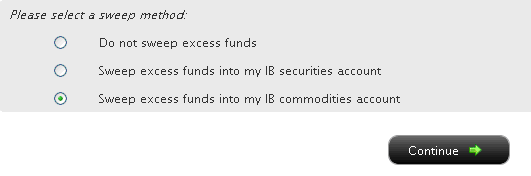
You may then select the radio button alongside the option of your choice and select the Continue button. Your choice will take effect as of the next business day and will remain in effect until a different option has been selected. Note that subject to the trading permission settings noted above, there is no restriction upon when or how often you may change your sweep method.
Selection Considerations
While the decision to elect one segment vs. the other for the purposes of maintaining excess cash may involve subjective decisions and preferences unique to each customer (e.g. customer maintains assets which are significant and concentrated in one segment vs. the other), outlined below are several factors warranting consideration:
1. Pattern Day Trading Equity - The securities buying power of accounts designated by regulation as Pattern Day Traders (i.e., 4 or more day trades within a 5 business day period) is limited by the lesser of the current or prior day’s closing equity in the securities segment. As such, an election to sweep excess funds to the commodities segment will prevent the inclusion of such funds in this calculation, thereby potentially limiting the capacity to enter new orders. To maximize the use of equity for purposes of entering securities orders, one would need to elect to sweep excess fund to the securities segment. Note that an election to the securities segment will not impair the ability to enter commodities orders as the pattern day trading rules do not apply to such accounts.
2. Insurance – SIPC protection is afforded to assets in the securities segment and there is no commensurate insurance scheme in place for the commodities segment. That being said, balances in excess of the SIPC $250,000 cash sub-limit ($900,000 Lloyd’s cash sub-limit, where applicable) are not afforded coverage. Customers of IB Canada and IB UK are also subject coverage rules as specified by CIPF and the FSCS, respectively.
3. Interest Income – all other things being equal, customers are likely to receive the most optimal interest income on long cash balances that have not been partitioned between the securities and commodities segments as they are not aggregated for interest credit purposes (since they are subject to distinct segregation pools and reinvestment rules). This, along with the fact that credits require maintenance of a minimum cash balance and that higher balances are afforded preferential rates are factors to be considered when making a sweep election.2
Other Relevant Knowledge Base Articles:
A Comparison of U.S. Segregation Models
A Comparison of U.S. Segregation Models
Footnotes:
1As OneChicago single stock futures are a hybrid product jointly regulated by the SEC and CFTC, they can be purchased and sold in either account type. IB, however, conducts such transactions in the securities segment of the Universal account as this is necessary to provide margin relief between the single stock future and any qualifying stock or option position.
2Consider, for example, an account which maintains a long USD balance of $9,000 in each of the securities and commodities segments. Depending upon the benchmark Fed Funds Effective rate, the account would be eligible to earn interest on $8,000 ($18,000 - $10,000) if the two balances were held in a single segment, but since balances below $10,000 in either of the two segments are not eligible for interest, could not earn anything without electing a sweep option. Similarly, one would be eligible to earn interest at a higher tier if as a result of a sweep election the account holder was then able to achieve a long USD cash balance above $100,000 in a given segment. For additional information regarding interest calculations including a link to current benchmark interest rates, refer to KB39.
Why does the "price" on hard to borrow stocks not agree to the closing price of the stock?
In determining the cash deposit required to collateralize a stock borrow position, the general industry convention is for the lender to require a deposit equal to 102% of the prior business day's** settlement price, rounded up to the nearest whole dollar and then multiplied by the number of shares borrowed. As borrow rates are determined based upon the value of the loan collateral, this convention impacts the cost of maintaining the short position, with the impact being most significant in the case of low-priced and hard-to-borrow shares. Note, for shares not denominated in USD the calculation will differ. Find below a table summarizing the calculations per currency:
| Currency | Calculation Method |
| USD | 102%; rounded up to the nearest dollar |
| CAD | 102%; rounded up to the nearest dollar |
| EUR | 105%; rounded up to the nearest cent |
| CHF | 105%; rounded up to the nearest rappen |
| GBP | 105%; rounded up to the nearest pence |
| HKD | 105%; rounded up to the nearest cent |
For US Treasuries and corporate bonds, the collateral amount on which the borrow fee is charged will include the accrued interest.
Account holders may view this adjusted price for a given transaction in the "Borrow Fee Details" section of the daily account statement. Two examples of this collateral calculation and its impact upon borrow fees are provided below.
Example 1
Sell short 100,000 shares of ABC at a price of $1.50
Short sale proceeds received = $150,000.00
Assume the price of ABC falls to $0.25 and the stock has a borrow fee rate of 50%
Short stock collateral value calculation
Price = 0.25 x 10²% = 0.255; round up to $1.00
Value = 100,000 shares x $1.00 = $100,000.00
Borrow fee = $100,000 x 50% / 360 days in year = $138.89 per day
Assuming the account holder's cash balance does not include proceeds from any other short sale transaction then this borrow fee will not be offset by any credit interest on the short sale proceeds as the balance does not exceed the minimum $100,000 Tier 1 threshold necessary to accrue interest.
Example 2 (EUR denominated stock)
Sell short 100,000 shares of ABC at a price of EUR 1.50
Assume a prior business day's close price of EUR 1.55 and a borrow fee rate of 50%
Short stock collateral value calculation
Price = EUR 1.55 x 10⁵% = 1.6275; round up to EUR 1.63
Value = 100,000 shares x 1.63 = $163,000.00
Borrow fee = EUR 163,000 x 50% / 360 days in year = EUR 226.38 per day
** Please note, Saturdays and Sundays are treated as a Friday and will use Thursday's settlement price to calculate the required deposit.
Interest Benchmark Definitions
Fed Funds Effective (USD only) is the volume weighted average of the transactions processed through the Federal Reserve between member banks. It is intended to reflect the best estimate of interbank financing activity for Reserve Bank members and is the reference for many short term money market transactions in the broader market.
EONIA (EUR only) is the global standard for overnight Euro deposits and is determined by a weighted average of the actual transactions between major continental European banks mediated through the European Central Bank.
HIBOR (CNY and HKD) is a daily fixing based on a group of large Hong Kong banks.
KORIBOR (KRW only) is an average of the leading interest rates for KRW as determined by a group of large Korean banks. The benchmark utilizes the KORIBOR with 1 week maturity.
STIBOR (SEK only) is a daily fixing based on a group of large Swedish banks.
TIIE (MXN only) is the interbank "equilibrium" rate based on the quotes provided by money center banks as calculated by the Mexican Central Bank. The benchmark TIIE is based on 28-day deposits so is atypical as a measure for short term funds (most currencies have an overnight or similar short term benchmark).
Overnight (O/N - CZK, HUF, ILS and SGD) rate is the most widely used short term benchmark and represents the rate for balances held from today until the next business day.
Spot-Next (S/N - DKK only) refers to the rate on balances from the next business day to the business day thereafter. Due to time zone and other criteria, Spot-Next rates are sometimes used as the short-term reference.
Day-Count conventions: it is beyond the scope of this document to describe day-count conventions and their use in interest calculations. IBKR conforms to the international standards for day-counting wherein deposits rates for most currencies are expressed in terms of a 360 day year, while for exceptional currencies (ex: GBP) the convention is a 365 day year.
Understanding interest charges when the net cash balance is a credit
An account will be subject to interest charges despite maintaining an overall net long or credit cash balance under the following circumstances:
1. The account maintains a short or debit balance in a given currency.
For example, an account maintaining a net cash credit balance equivalent to USD 5,000 comprised of a long USD balance of 8,000 and a short EUR balance equivalent to USD 3,000 would be subject to an interest debit based upon the short EUR balance. There would be no offsetting credit on the long USD balance as it is less than the USD 10,000 Tier I level above which interest is earned.
Account holders should note that in the event they purchase a security which is denominated in a currency that they do not hold in their account, IBKR will create a loan in that currency in order to settle the trade with the clearinghouse. If one wishes to avoid such loans and their associated interest charges, they would need to either deposit funds denominated in that particular currency or convert existing cash balances via the Ideal Pro (for balances of USD 25,000 or above) or odd lot (for balances less than USD 25,000) venue prior to entering into your trade.
2. The credit balance is comprised principally of proceeds from the short sale of securities.
For example, an account maintaining a net cash credit balance of USD 12,000 which is comprised of a USD debit of 6,000 in the security sub-account (less the market value of any short stock positions) and a short stock market value credit of USD 18,000 would be charged interest on the Tier 1 debit of USD 6,000 and would earn no interest on the short stock credit as it falls below the USD 100,000 Tier I level.
3. The credit balance includes unsettled funds.
IBKR determines interest debits and credits solely based upon settled funds. Just as an account holder is not assessed interest charges on funds borrowed to purchase a security until such time that purchase transaction settles, the account holder will not receive an interest credit, or offset against a debit balance, on funds originating from the sale of a security until such time the transaction has settled (and IBKR has been credited funds by the clearinghouse).
