
Ex-Ante Costs and Charges Disclosures
概観:
What is this Disclosure?
MIFID II rules require that Interactive Brokers in Europe and the UK provide its retail clients with a reasonable estimate of the costs and charges related to products and services offered.
Retail clients of Interactive Brokers in Europe can view a per-transaction costs and charges disclosure at the time of the order entry (‘ex-ante’). The disclosure is personalized and corresponds to the conditions applicable to the client account.
While clients have the option to view the disclosure, it is not a mandatory step before the order submission.
The disclosure content and format are largely prescribed by the rules to enable retail clients to compare costs and charges across providers. This article aims to clarify the meaning of these standardized terms.
In addition to Interactive Brokers costs and charges, the disclosure must show implicit costs and costs embedded in the product price itself (and not charged by Interactive Brokers separately).
A per transaction costs and charges disclosure is required for:
- All futures and options globally, including futures options
- ETFs of all types
- Funds, including closed-end funds
- CFDs
- Warrants and structured products
A disclosure is not required for other products such as vanilla stocks and bonds.
Where to Find the Per-transaction Costs and Charges Disclosure?
Access to the disclosure is via a link embedded in the primary order-entry dialog.
TWS Classic:
.png)
The presence of the link does not interrupt the standard order entry workflow if a client chooses not to click it. A client can click the transmit button in the usual way and skip viewing the disclosure.
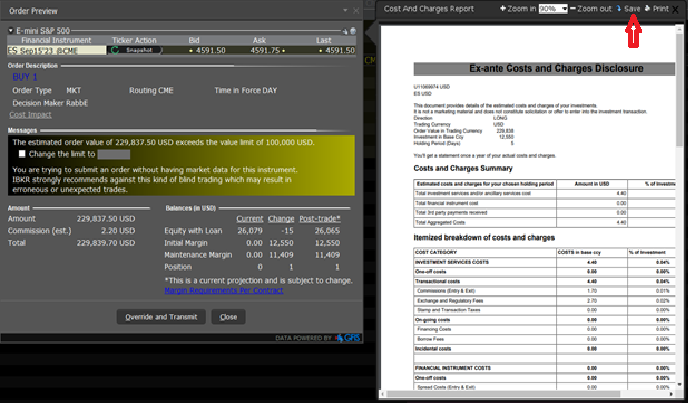
Clicking the “Cost Impact” link brings up a pop-up with the ex-ante per transaction costs and charges disclosure, with the option to download it as a PDF:
Other Trading Applications:
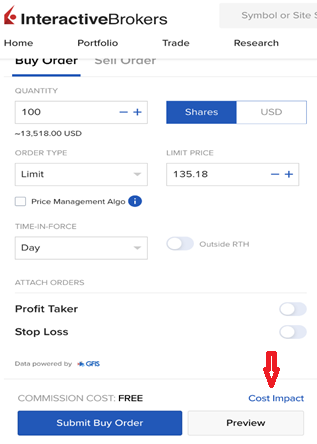
The other order entry interfaces such as Mosaic, Client Portal and Mobile likewise include a link to the costs and charges disclosure, again without interrupting the standard workflow unless a client expressly wants to see the disclosure.
Below is an example of the order ticket in the Client Portal. Order tickets in TWS Mosaic and Mobile are similar.
The Disclosure Content and Structure
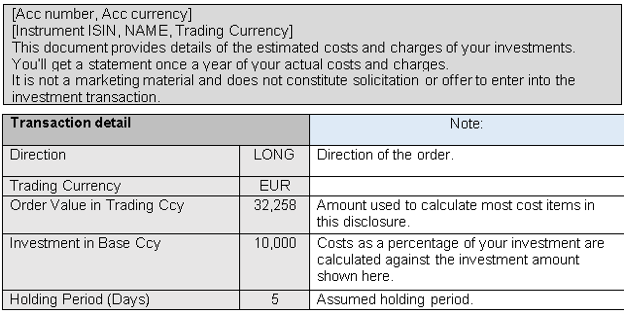
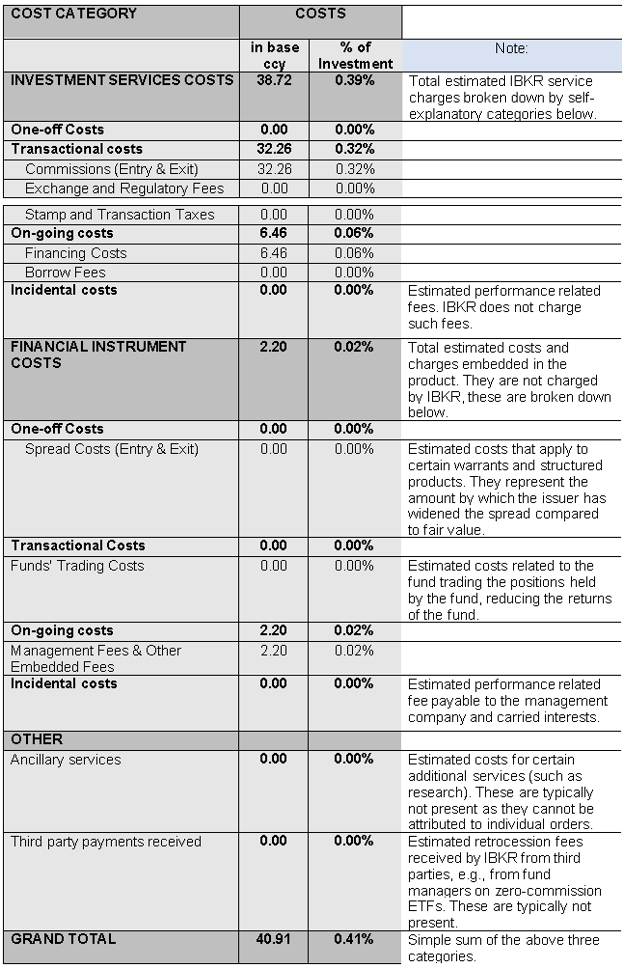
The per transaction costs and charges disclosure includes a summary-section followed by an itemized costs and charges breakdown. The various cost items are presented using headings and terms that are mandated by the regulation to make the disclosures comparable across investment service providers. The example below illustrates the statement structure and contains explanatory notes.
Ex-ante Costs and Charges Disclosure - Illustrative Example
(1) Account detail
(2) Costs and Charges Summary
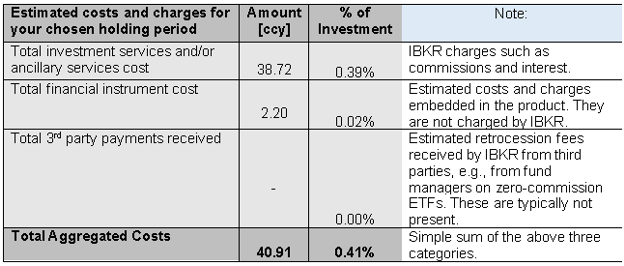
Please note that the “Financial Instrument Cost” is embedded in the product, and not a cost charged by Interactive Brokers. We are required to source or estimate such costs so you could better understand all of the costs that are associated with some of your securities.
(3) Itemized Breakdown of Costs and Charges
Alternative Streaming Quotes for European Equities
Alternative Streaming Quotes for EU Equities
On August 1st, 2022, clients with non-professional or non-commercial market data subscriber status will receive complimentary real-time streaming Best Bid and Offer and last sale quotes on European Equities. These quotes will be aggregated from exchanges such as Cboe Europe, Gettex, Tradegate and Turquoise. The data will display in the SMART quote line and can be used to generate a chart as well.
Eligible users will see a no charge service called 'Alternative European Equities (L1)' added to their account on or before August 1, 2022. Please note this will be a default Market Data service that cannot be removed.
Users who would like to receive the full EBBO (European Best Bid and Offer) will need to subscribe to the individual exchange subscriptions.
FAQs for February 23, 2022 messages regarding CME exchange fee credits
Why did I receive this message?
You received a message from IBKR on February 23, 2022 because your account traded spread trades on CME in (1) one or more of the following products between January 1, 2015 and late September 2021: E-Mini Equity index Futures (including Housing Index Futures); Micro E-Mini Index Futures; Micro E-Mini Index Options; and Nikkei Equity Futures, and/or (2) certain FX futures products between February 1, 2018 and mid-December 2021.
Why did I receive a credit?
As set forth in the message, certain spread trades in those products (see response #1) are subject to discounted CME exchange fees (as compared to outright trades in those products). Your account traded spread trades in one or more of those products between January 1, 2015 and late September 2021 (or FX futures between February 1, 2018 and mid-December 2021) and, as a result of an inadvertent error, overpaid associated CME exchange fees. IBKR has credited your account for the overpaid CME exchange fees.
What do I need to do?
You will need to log into your account and withdrawal the funds.
Am I owed money for other trades?
Not that we have identified.
How long do I have to withdraw the funds?
Please withdraw the funds within 30 days of the date of the message you received (by March 25, 2022).
The message I received says something about owing an outstanding debt to IBKR. What does that mean?
This means that your account owed an outstanding debt to IBKR, and the amount you received in reimbursement was credited against the outstanding debt amount. If the reimbursement amount exceeded the outstanding debt about, you received a credit and may withdraw the difference.
証券に利用可能なマーケットデータ購読の見分け方
IBKRでは、口座をお持ちのお客様に、取引をご希望の証券(株式、オプション、またはワラント)に利用可能な購読サービスを選択するためのマーケットデータアシスタントツールをご提供しています。検索結果には商品の取引される取引所すべて、プロフェッショナルおよび一般購読者のお客様向けの購読とその月額料金、またそれぞれの購読に関連する市場の変動の深さが表示されます。
マーケットデータアシスタンスへのアクセス方法:
- クライアント・ポータルにログインしてください
- サポートセンターに続いて、ヘルプ(右上端のクスチョンマークのアイコン)をクリックしてください
- 下にスクロールして、マーケットデータアシスタントを選択してください
- シンボルかISINを入力してから取引所を入力してください
- 任意のフィルターに入力する内容を選択してください: プロフェッショナル/一般購読者のステータス、通貨、資産
- 検索をクリックしてください
- 検索結果より購読可能なものを確認し、ご自身のニーズに合ったものを選択してください
移行後のIBKRへの送金方法
お客様の口座が最近IBKRアイルランド(IBIE)、またはIBKR中央ヨーロッパ(IBCE)に移行した場合には、クライアント・ポータルや銀行に保存されているバンキング・インストラクションが古いもののままになっている可能性があります。移行後、IBKRに資金を送金される際には、クライアント・ポータル内で新しい入金通知/バンキング・インストラクションを入力し、銀行に保存されているIBKRのバンキング情報を更新してください。
誤って古いバンキング・インストラクションを使用してIBKRにご送金され、これが誤ったIBKRの事業体に送金された場合、弊社では正しいIBKRの事業体に資金を転送するように試みます。この送金は初回は無料となりますが、それ以降の送金には処理費用としEUR 50(またはこれに相当する額)をお口座にご請求させていただきますのでご了承ください。また、送金のお知らせおよび、バンキング情報の更新が必要である旨のメッセージもお送り致します。
オプションにかかる規制機関手数料(ORF)
ORFは、OCCがIBKRを含める決済メンバーから徴収する取引所手数料です。 目的は、オプション市場の監督および規制に関連する取引所費用を補うことにあります(例:定期的な監視、調査、ならびに方針、規則の制定、解釈、施行に関連する活動など)。この手数料のそれぞれの取引所における開始時期は以下の様になります:CBOEにおいて2009年半ば、BOXそれぞれ、ISEおよびPHLXにおいて2010年1月、AMEXおよびACRAにおいて2011年5月、Nasdaqにおいて2012年1月、C2において2012年8月、Miamiにおいて2013年1月、ISE GEMINIにおいて2013年8月、BATSにおいて2015年2月、Nasdaq BXにおいて2016年2月、BATS EDGXにおいて2017年2月、PEARLにおいて2017年2月、MERCURYおよびEMERALD2019年2月。手数料は現在、顧客の注文に対して、米国取引所に上場されているオプションコントラクト1枚あたり$0.02135で査定されており、取引所ごとのレートは以下の様になります:
| 取引所 | ORF |
| AMEX | 0.0055 |
| ARCA | 0.0055 |
| BATS | 0.0001 |
| BOX | 0.00295 |
| CBOE | 0.0017 |
| C2 | 0.0003 |
| EDGX | 0.0001 |
| EMERALD | 0.0006 |
| ISE | 0.0000 |
| GEMINI | 0.0000 |
| MERCURY | 0.0004 |
| MIAX | 0.0019 |
| NOM | 0.0000 |
| NASDAQBX | 0.0005 |
| PEARL | 0.0018 |
| PHLX | 0.0000 |
| 合計 | 0.02135 |
ORF は、IBKRの手数料や既存の取引所手数料(例:流動性の排除など)に加えて、買いおよび売りの両方の取引すべてに課され、規制機関手数料としてアクティビティーステートメントに反映されますのでご注意ください。
Sending Funds to IBKR Post Migration
If your account has recently migrated to IBKR Ireland (IBIE) or IBKR Central Europe (IBCE), it is likely that you have outdated bank instructions saved in your Client Portal or with your bank. When transferring funds to IBKR after migration, you will want to enter a new deposit notification/bank instruction within Client Portal and update any saved IBKR bank information that you have with your bank.
Should you inadvertently use outdated bank instructions to send funds to IBKR and they arrive at the incorrect IBKR entity, as a courtesy we will attempt to forward the funds to the correct IBKR entity. Please note that this transfer will be done free of charge for the first instance. For subsequent transfers, IBKR will charge your account a processing fee of EUR 50 (or equivalent). You will also receive a message notifying you of the transfer and advising you to update your bank information.
サードパーティ取引費用に関するサマリー
印紙税および取引税(該当する場合)は、通常のIBKR手数料に加えてお客様にパススルーされます。印紙税の詳細は、アクティビティ・ステートメントの取引手数料の項目よりご確認いただけます。下記は各国で請求される税金のリストになります。
イギリス
- 取引価値の0.5%の印紙税
- 英国、マン島、チャネル諸島で登録されている企業の株式を対象とし、GBP 10,000以上のすべての注文に対して、GBP 1.00の買収/合併に関連するパネル税が課せられます。
アイルランド
- 取引価値の1%の印紙税
スイス
- スイスの取引税は、各口座に対して弊社が自動的に請求することはありません。課税対象となるお客様でサポートが必要な方は、地元の税理士にご相談ください。
フランス
- フランスにおける金融取引税: フランスに本社があり、時価総額が10億ユーロを超える企業の株式には、取引額の0.30%が適用されます。
イタリア
- イタリアにおける金融取引税: 規制市場およびMTFで取引される株式には0.10%、規制市場以外で取引される株式には0.20%が適用されます。
スペイン
- スペインにおける金融取引税: 取得日の前年12月1日の時点における時価総額が、1憶ユーロを超えるスペイン企業の株式に0.20%または取引額が適用されます。
ベルギー
- 証券取引所での取引(TST)にかかるベルギーの税金は、弊社が個人口座に自動的に請求することはありません。課税対象となるお客様でサポートが必要な方は、地元の税理士にご相談ください。
香港
- SEHKで取引される株式、ワラント、および仕組み商品は以下のようになります:
- 政府の印紙税: 0.13%。通常は株式のみに適用され、SEHK株式には一番近い1.00に切り上げ
- SFC取引課税: 0.0027%。通常は株式、ワラント、ならびにCBBCに適用
- FRC取引課税: 0.00015%。通常は株式、ワラント、ならびにCBBCに適用
- 上海・香港ストック・コネクトノースバウンド取引リンクおよび深セン・香港ストック・コネクトで取引される商品は以下のようになります:
- 売上代金の0.1%の印紙税
諸費用に関する概要
お客様および将来的に弊社のご利用をお考えの方は、料金の詳細が記載されている、弊社のウェブサイトをご覧いただくことをお勧め致します。
最も共通的な手数料や諸費用の概要は以下のようになります:
1. 手数料 - 商品の種類や上場取引所、またセットプラン(すべて一括)や別プランかなどの選択によって異なります。例えば米国株の場合、取引あたり$1.00を最低限として、1株あたり$0.005を手数料として設定しています。
2. 金利 - 証拠金によるマイナス残高には金利がかかりますが、弊社では国際的に認められたオーバーナイトのベンチマークを使用して金利を決定しています。さらに、ベンチマーク金利(「BM」)にスプレッドを適用し、残高が大きいほど金利が高くなるように設定して、実効レートを決定しています。 例えば、米ドル建てのローンの場合、ベンチマーク率はフェドファンドの実行レートで残高が10万ドル以下の場合には、ベンチマーク1.5%のスプレッドが追加されます。 また株式の空売りの際には、これをカバーするために借りた株式が「借入困難な銘柄」とみなされる場合、日次で表示される特別な手数料が適用されます。
3. 取引所手数料 - これもまた商品の種類や上場取引所によって異なります。例えば、米国の証券オプションの取引所では、流動性が失われると(成行注文または約定のつく指値注文)支払い手数料が発生し、また流動性が追加されると(指値注文)受取り手数料が発生することがあります。また、多くの取引所では注文のキャンセルや変更に手数料を設けています。
4. マーケットデータ - マーケットデータのご購読は必要ありませんが、購読する場合には、ベンダーの取引所と購読サービスによっては月額料金が発生することがあります。弊社では、お客様が取引を希望される商品に応じて、適切なマーケットデータ購読サービスを選択するための、マーケットデータ・アシスタントツールをご提供しています。ポータルにログインしてサポートの項目をクリックし、マーケットデータ・アシスタントのリンクを選択してください。
5. 月間最低アクティビティ手数料 - 弊社ではアクティブなトレーダーのお客様を対象としているため、毎月最低額の手数料が発生しない場合には、差額をアクティビティ手数料としてお支払いいただきます。最低額は月あたり$10です。
6. その他の諸費用 - IBKRでは月に1回の出金は無料になっていますが、それ以降の出金には手数料が設定されています。また、取引のバスト・リクエストやオプションや先物の権利行使や割当て、ADRカストディアン手数料など、お客様にパススルーされる手数料があります。
さらに詳しい情報は、弊社ウェブサイトの「諸費用・海外口座手数料」のメニューより該当するオプションを選択してご確認ください。
Summary of Third Party Transaction Fees
Stamp taxes and transaction taxes, where applicable, are passed through to Interactive Brokers clients on top of the standard IBKR commission charge. You can see details of any stamp taxes charged in the Transaction Fees section of your Activity Statements. Below is a list of the taxes charged by various countries.
United Kingdom
- 0.5% of trade value Stamp Tax
- Panel of Takeovers and Mergers Levy of GBP 1.00 on all orders over GBP 10,000 on shares of companies registered in the United Kingdom, Isle of Man or Channel Islands
Ireland
- 1% of trade value Stamp Tax
Switzerland
- The Swiss transaction tax is not charged automatically by Interactive Brokers on individual accounts. Clients who are subject to the tax should consult a local tax advisor for support with their tax obligations.
France
- French Financial Transaction Tax: 0.30% of trade value applied to shares of companies whose head office is located in France and whose market capitalisation exceeds EUR 1 billion
Italy
- Italian Financial Transaction Tax: 0.10% for shares transacted on regulated markets and MTFs and 0.20% for those transacted outside of these markets.
Spain
- Spanish Financial Transaction Tax: 0.20% or trade value applied to shares of Spanish companies whose market capitalisation exceeds EUR 1,000 million as of December 1 of the year preceding the date of acquisition.
Belgium
- The Belgian Tax on stock-exchange transactions (TST) is not charged automatically by Interactive Brokers on individual accounts. Clients who are subject to the tax should consult a local tax advisor for support with their tax obligations.
Hong Kong
- For stocks, warrants and structured products traded on the SEHK:
- Government stamp duty: 0.13%, rounded up to the nearest 1.00 for SEHK stocks, normally applies only to stocks
- SFC transaction levy: 0.0027%, normally applies to stocks, warrants and CBBCs
- FRC Transaction levy: 0.00015%, normally applies to stocks, warrants and CBBCs
- For products traded on the Shanghai-Hong Kong Stock Connect Northbound Trading Link and Shenzhen-Hong Kong Stock Connect:
- 0.1% Sale Proceeds Stamp Duty
